French (Canada)
 English (United States)
 English (UK)
 German
 French (France)
 Spanish

Steering Angle Sensor Calibration After an Alignment or Steering Repair

An alignment can leave the steering wheel straight and the tires tracking correctly, and the stability-control light can still come back on the first drive around the block. The missing step is often a steering angle sensor calibration. The sensor tells the ESC, ABS, and related systems where the steering wheel is pointing. After you change toe, replace a rack, work on a clock spring, or sometimes after a battery disconnect or a collision, that sensor’s idea of “straight” no longer matches the road. Until you calibrate it with a scan tool, the car may set a steering-angle code, disable traction or stability control, or annoy the driver with a lamp that the alignment itself did not fix.
This is a specific service function, not a generic code clear. A basic lecteur de code can show a C-code or a chassis fault. It will not usually teach a new zero point.
Why the sensor needs a fresh zero
The steering angle sensor, often in the steering column behind the wheel or combined with the clock spring, reports angle and sometimes rotation speed. The stability system compares that to wheel-speed and yaw data to decide whether the car is going where the driver is steering.
If you change the relationship between the wheel and the road — a toe adjustment, a rack replacement, a tie-rod, a steering-column or clock-spring job — the old calibration can be wrong even when the steering wheel looks straight in the shop. Some vehicles also lose their calibration after a low 12-volt battery or after a module is replaced. The result is not always a dramatic pull. More often you get a traction or ESC lamp, a stored steering-angle or “sensor not calibrated” code, and a system that has gone into a reduced mode.
Do not confuse this with the alignment itself. Calibration does not set toe. If the rack is off-center or the wheel is physically crooked, calibrate after you correct that, not before. Teaching a crooked wheel as “zero” will only store a bad value.
When you should plan a calibration
Build the step into the job when you have done any of the following:
- A four-wheel or front-end alignment, especially if toe was changed or the steering wheel was not already straight.
- Steering-gear, inner or outer tie-rod, or subframe work that changed steering geometry.
- Clock-spring, steering-wheel, or column replacement.
- ABS or ESC module replacement, or a repair that required the battery to be disconnected for a long time, on vehicles that the service information says need a relearn.
- A customer complaint of an ESC or traction lamp after recent alignment or steering work, even if the car “drives straight.”
If an ABS, traction, or airbag light is on, read all chassis and SRS modules first. A steering-angle fault can sit next to a wheel-speed sensor code or a yaw-sensor code. Calibrating over the top of a failed wheel-speed sensor will not turn the light off for long.
What kind of tool you need
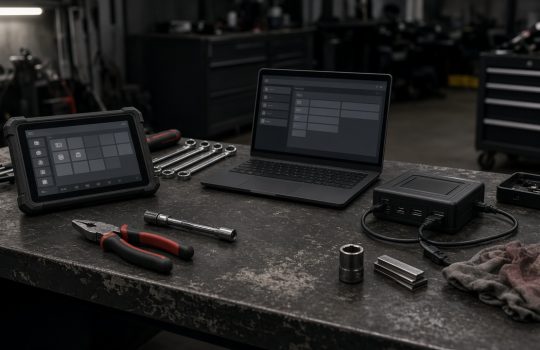
You need a outil de balayage bidirectionnel or a service-capable scanner that supports steering-angle, SAS, or “steering angle reset” for that exact vehicle. Coverage lives in the ABS, ESC, steering, or chassis menu, not in generic OBD2. Mid-level tools such as the Autel MaxiCOM MK808BT Pro, le Foxwell NT630 Plus, or an XTOOL D7S are in the class of tool this job usually takes, provided the software lists that model.
On a late-model Chrysler, Dodge, Jeep, or RAM, a passerelle sécurisée can block the chassis module until you have authorized access. If the tool cannot enter the ABS or ESC menu, fix that before you assume the sensor is bad.
Turning the steering wheel from lock to lock, or disconnecting the battery, is not a reliable substitute. Some older vehicles had a simple relearn during a straight drive. Many late-model US-market cars expect a commanded calibration with the wheels straight on a level surface.
A careful, repeatable procedure
Always follow the on-screen and service-information steps for the vehicle in the bay. The pattern is usually:
- Put the vehicle on a level surface, or complete the alignment so toe and the steering wheel are correct first.
- Point the front wheels straight ahead, with the steering wheel centered and unobstructed. Do not rest a tool or a scan-tool cable in a way that holds the wheel off-center.
- Set tire pressures to spec. A large pressure difference can confuse related calibrations on some cars, and it belongs in the alignment anyway.
- Connect the scan tool, switch the ignition on, and select the steering angle, SAS, or equivalent function. Some procedures want the engine running; some want it off. Do not guess.
- Confirm any prompts — “wheels straight,” “do not touch the wheel,” “turn slowly lock to lock,” or “drive straight at a given speed.” Complete them without rushing.
- Read the sensor value after the routine. You want a near-zero angle with the wheel straight. If the tool still shows a large offset, the wheel is not actually straight, or the sensor or clock spring has a fault.
- Clear the related codes only after a successful calibration, then take a short straight-line road test and a few gentle turns. Confirm that the ESC and traction lamps stay off and that no steering-angle code returns.
If the function fails, do not keep commanding it. Check battery voltage, module communication, and whether the sensor itself is reporting a believable angle as you slowly turn the wheel. A sensor that jumps, drops out, or never leaves one value needs diagnosis, not another calibration attempt.
After an alignment, treat calibration as part of the quality check
Shops that do a lot of alignments should treat SAS calibration as a closing step on vehicles that have a steering angle sensor, not as something you add only when the light comes back. The customer may not feel a problem in the parking lot. The first highway merge, in the rain, is a poor time to discover that ESC is disabled.
If you subcontract alignments, or you take in a car that was aligned elsewhere, still scan the chassis modules when a lamp is on or a steering repair was just completed. A “we already aligned it” story is one of the most common reasons a steering-angle code is overlooked.
Steering angle sensor calibration is a short procedure when you have the right scan tool and a level, straight vehicle. Do it after the mechanical work, confirm a near-zero reading, and road-test the lamps. That is how an alignment or a rack replacement stays finished when the car leaves the bay.