 English (United States)
 English (UK)
 German
 French (France)
 French (Canada)

What Is Injector Coding and Why It Matters After a Repair
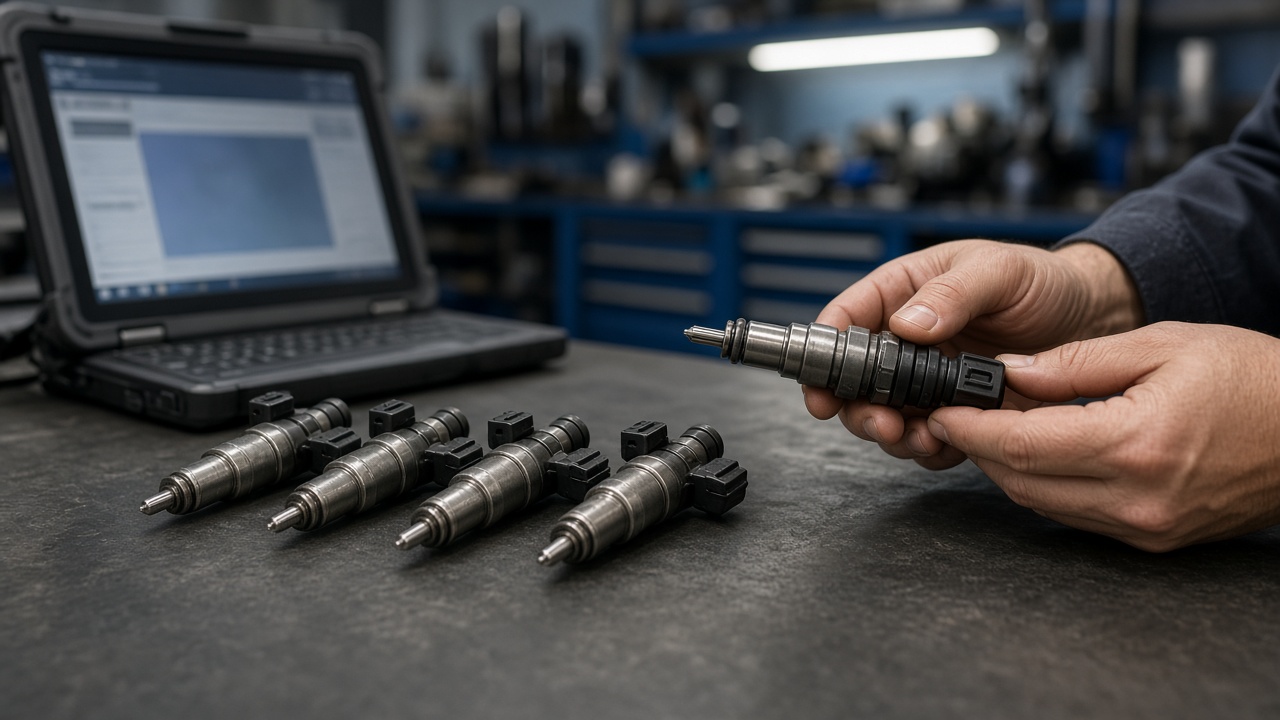
You replace a leaking or failed fuel injector, clear the codes, and start the engine. It idles roughly, smokes, or sets a new imbalance code before the vehicle even leaves the bay. The mechanical install can be perfectly fine. What is missing, on many modern engines, is injector coding.
Injector coding tells the engine computer how a specific injector flows, so the ECU can correct for small differences between cylinders. Skip it when the vehicle requires it, and a good part can still drive like a bad one. This article explains what the procedure is, when it matters, and what to look for in a scan tool.
What Injector Coding Actually Is
Fuel injectors are manufactured to tight tolerances, but they are not identical. On many common-rail diesel engines, and on some gasoline direct-injection engines, each injector has a calibration code printed on the body as a string of letters and numbers. Manufacturers refer to these values with names such as IMA, IQA, or a similar calibration ID, depending on the brand.
The ECU uses that code to adjust injection quantity and timing for that cylinder. Injector coding is the service function that writes the new injector’s code into the control module, often along with a related adaptation or learn procedure.
This is not the same as module coding or ECU programming, a bi-directional injector test that commands a click or cutoff, or cleaning injectors on a bench. Those jobs can be related, but they do not replace coding when the vehicle specifies it. For a wider view of service menus, see Scan Tool Service Functions Explained.
When You Need to Code Injectors
Always follow the service information for the exact engine. In general, coding or a related adaptation comes up after replacing one or more injectors; replacing the engine control module, which may have no injector codes stored; swapping injectors between cylinders (which some procedures discourage and others allow only if you recode each position); or certain repairs that required the ECU to be initialized.
Some engines do not use a written injector code at all, or they use a different learn process after installation. Check coverage and the factory procedure for the vehicle and year instead of assuming every injector job needs the same menu.
What Happens If You Skip It
When the ECU is still using the old injector’s calibration — or a default that does not match the new part — common results include a rough cold idle, vibration or uneven contribution from one cylinder, excess smoke on a diesel or a fuel-trim and misfire complaint on a gasoline engine, imbalance or quantity codes that return after you clear them, and in some cases reduced power.
It is easy to blame the new injector, the high-pressure pump, or a wiring connector. Before you condemn a second part, confirm whether coding or a learn procedure was completed and accepted by the ECU.
How the Procedure Usually Goes
The exact screens differ by manufacturer and tool, but a careful job follows the same outline.
- Read and record the original codes first, if the injectors are still in the engine and the ECU still communicates. Store the cylinder order. Photos of the injector tags help if a code is hard to read later.
- Complete the mechanical work correctly. Use new seals as required, keep dirt out of the rail and ports, and torque to specification. High-pressure fuel systems are dangerous; relieve pressure and follow the service manual.
- Enter the new calibration code for each replaced injector in the correct cylinder position. Double-check every character. A single mistyped digit can look like a failed injector.
- Complete any required follow-up routine, such as an idle learn or a road-test adaptation, if the tool and service information call for it.
- Verify with data, not just a start-up. Review fuel trims, contribution or correction values, and related live data. Take a test drive, then rescan. If a correction value is pinned at its limit, the code may have been entered wrong, or there is still a mechanical problem.
A successful click test does not prove the calibration code was written.
What to Look For in a Scan Tool
You need a diagnostic tablet with official injector-coding (or the maker’s equivalently named) coverage for that vehicle, not a basic OBD2 code reader. The function may sit under special functions, service, or coding, and it may be listed only for certain engines in a model line.
Tablets to review include the Autel MaxiCOM MK900-BT, the coding-capable MaxiDAS DS900BT and MaxiPRO MP900-BT, and shop-level tools such as the MaxiSYS MS909 and MaxiSYS Ultra. The TOPDON Phoenix Plus 2 officially includes ECU coding and a large service menu; you still have to confirm injector coding for the specific engine. Our MaxiSYS lineup guide can help if you are shopping at the professional end, or browse the diagnostic tools category.
Do not promise the job until you have checked function-level coverage for that year and engine. “This tablet does coding” is not the same as “this tablet can write injector IMA codes on this truck.”
Practical Shop Tips
Write codes with the battery supported, because a mid-procedure voltage drop can interrupt a write. Keep injector tags until the vehicle has been verified. Replace and code one injector at a time when the procedure allows it; some jobs require a complete set. After coding, do not ignore a return of the same code — coding does not fix a fuel-pressure problem, a wiring fault, or an injector damaged on installation.
FAQ
Can I copy codes from the old injectors onto new ones? No. The code describes that physical injector. New parts get the codes printed on them, and those are the values the ECU needs. Injector coding is most often discussed on common-rail diesels, but some gasoline direct-injection engines also require a coding or learn procedure. If the tool rejects a code, recheck the tag, the cylinder, and the coverage before you assume the injector is defective.
The Bottom Line
Injector coding is how the ECU learns the calibration of a replacement injector. On engines that require it, the repair is not finished when the fuel rail is torqued; it is finished when the codes are written, any required adaptation is complete, and the live data looks sane. Use a scan tool with confirmed coverage, enter the values carefully, and verify the result before the vehicle goes back to the customer.


