French (France)
 English (United States)
 English (UK)
 German
 Spanish
 French (Canada)

How to Do an Electronic Parking Brake (EPB) Service with a Scan Tool

Plenty of US cars and light trucks no longer have a pedal or a conventional cable handbrake. An electronic parking brake (EPB) uses a switch, a module, and either a motor on each rear caliper or a module that tensions cables. That is convenient for the driver and easy to get wrong in the bay. If you compress a motor-on-caliper piston the old way, you can damage the mechanism, set a brake warning, and leave the parking brake unable to apply or release. An electronic parking brake EPB service with a scan tool is the correct way to put those calipers into a maintenance position, replace pads or rotors, and clamp them back up.
This article is the hands-on brake-job side of the work. For a broader map of oil resets, EPB, SAS, and other built-in routines, see scan tool service functions explained.
Know which EPB system you have
Before you unbolt anything, identify the hardware:
- Motor-on-caliper. An electric motor and gearbox sit on the rear caliper. This is common on many Ford, GM, Volkswagen, Toyota, Honda, and Hyundai-Kia products in the US. The piston must be retracted electrically before you push it back for new pads.
- Cable-actuated EPB. A module in the rear pulls cables to mechanical calipers or drums. You still may need a scan-tool release or a special service mode, but the pad job itself can look more familiar.
- Integrated electronic brake modules. Some late-model vehicles combine EPB with the ABS or stability system. If a gateway or module will not talk, you cannot complete the service.
Open the service information for that year, make, and model. A cabin button or a long press of the EPB switch is not a substitute for the official retract procedure on most motor-on-caliper designs.
A basic code reader is not enough
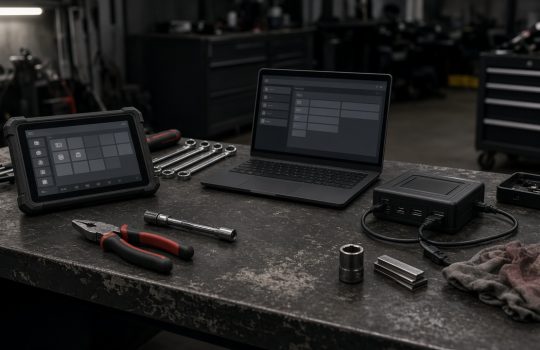
EPB service is a bi-directional or service-function job. A simple OBD2 code reader that only pulls engine codes will not retract a Ford or Chevy rear caliper. You need a scan tool that supports the vehicle’s brake or EPB module and lists a function such as “Workshop mode,” “Maintenance position,” “Pad replacement,” or “Open/close rear caliper.”
Mid-level service tools such as the Foxwell NT650 Pro and all-system tablets such as the Autel MaxiCOM MK808BT Pro are the class of tool this job usually requires. Coverage still varies by year and model, so confirm EPB support for the car in the bay, not just the brand name on the tool.
On a late-model Chrysler, Dodge, Jeep, or RAM, a secure gateway can block the module until you have the right access. If the tool connects to the engine but will not enter the brake module, fix communication first. Do not pry the caliper apart while you guess.
Set the vehicle up safely
EPB service is still brake work. Treat it that way.
- Park on a level surface, chock the front wheels, and support the vehicle on a lift or jack stands. Do not rely on the electronic parking brake to hold the car while you are under it.
- Make sure the 12-volt battery is healthy and stable. A sagging battery can interrupt the retract or apply command and leave a caliper stuck mid-travel. Support the battery if voltage is marginal.
- Connect the scan tool, switch the ignition on, and allow the tool to identify the vehicle. Close doors if the vehicle likes to time out accessories with a door open, or follow the on-screen prompts.
- Look for existing brake, ABS, or EPB codes and note them. A motor that already has a fault may not retract, and that is useful to know before the car is in pieces. A new ABS or brake warning after the job should be compared with what was already stored.
Keep fingers and tools clear of the caliper when the motor runs. The piston and mechanism will move under power.
Retract, service, then re-clamp
The exact menu name changes by brand, but the order of work is consistent:
- Select the EPB or brake service function and choose the maintenance or retract position. Wait until the tool confirms the motors have reached that position. Do not start unbolting the caliper while the command is still running.
- Remove the caliper, hang it so the hose is not stretched, and replace pads, hardware, and rotors as specified. On a motor-on-caliper unit, do not wind the piston back with a conventional cube tool unless the service information says that method is approved for that design. Many are retracted only by the scan tool.
- Reinstall the caliper, torque the bracket and guide pins to spec, and confirm the pads sit squarely.
- Return to the scan tool and run the apply, close, or “exit workshop mode” function so the mechanism clamps the new pads. Some vehicles want you to press the brake pedal or cycle the EPB switch during this step. Follow the prompts rather than inventing a shortcut.
- Cycle the parking brake on and off with the vehicle still safely supported, then again on the ground, and confirm the rear wheels lock and release as they should.
If the function fails mid-procedure, do not keep commanding it. Check battery voltage, connections, and EPB-module codes, then retry.
After the job: lights, pedals, and a short road test
New pads need a sensible clamp and a short bedding drive, just as they do on a conventional rear brake. Also confirm:
- The EPB applies and releases from the switch, and the dash indication matches what the wheels are doing.
- The brake pedal feel is firm after a few slow stops, and there is no grind, clunk, or persistent warning lamp.
- Any service light that came on during workshop mode has gone out after you exited the function. If a lamp stays on, read the brake and ABS modules again before you release the car.
- Some vehicles need a parking-brake calibration or a pad-thickness reset after replacement. If the tool offers it and the service information calls for it, do it now, not after a comeback.
A soft pedal or a light that returns on the first driveway test is a signal to get the car back in the air, not a reason to clear codes and hope.
Common ways an EPB job goes sideways
Most EPB problems after a brake job are process problems: the caliper was compressed without a service mode, the battery died mid-command, the tool could not actually talk to that module, or the parking brake was used as the only thing holding the vehicle.
Build EPB into the way you estimate rear brake work on late-model cars. If the vehicle has an electronic parking brake, the job includes scan-tool time, a stable battery, and a function check before the car leaves the bay. Done in that order, EPB service is a routine shop task, not a special event — and you avoid turning a pad replacement into a caliper and module repair.